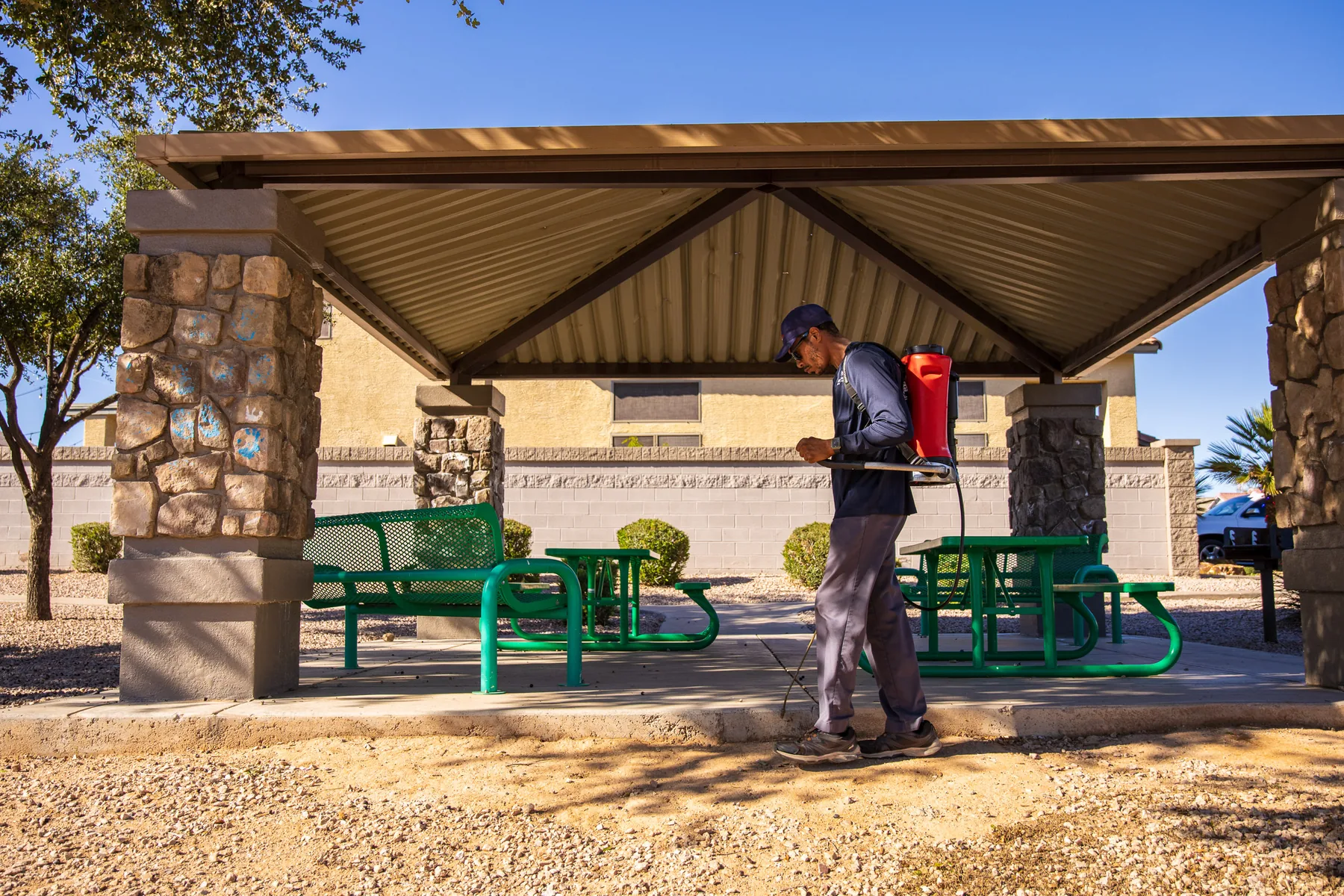
Termite Treatment
Termite treatment in Fountain Hills and the East Valley
Cummings Termite & Pest has protected Arizona homes and businesses from termites since 1972. Schedule your free inspection today.
- Family-owned since 1972
- Certified & fingerprinted techs
- Free inspections
- Residential & commercial
Overview
Professional termite treatment in Arizona
Cummings Termite & Pest provides professional termite inspections and treatments for residential and commercial properties throughout Fountain Hills, Scottsdale, Mesa, Gilbert, Chandler, and the surrounding East Valley. Our certified technicians identify termite activity, assess the extent of damage, and build a treatment plan tailored to your specific property and soil conditions — all starting with a free inspection.
We treat subterranean termites using proven liquid barrier applications and baiting and monitoring station programs. For new construction, we also offer pre-construction pre-treatment to protect your investment before the slab is poured. Every plan is customized to the structure, the site, and the level of activity we find — because no two Arizona properties are exactly alike.
With over 50 years of experience in the desert Southwest, our family-owned team understands how Arizona's climate and soil types create conditions where termite pressure is constant. You get direct communication, safe and professional treatments, and the confidence that comes from working with a company that has served this region for generations.
Quick comparison
Termites vs. ants: how to tell them apart
Swarming termites are easy to mistake for flying ants. Before you call, here's how to tell which one you're actually dealing with.
| Attribute | Subterranean termites | Ants |
|---|---|---|
| Waist | Broad — the body looks like one thick segment with no pinch | Narrow, clearly pinched waist between segments |
| Antennae | Straight and bead-like | Bent or elbowed |
| Wings (swarmers) | Four wings of equal length; shed near windows and light fixtures | Front wings longer than the back pair; rarely shed indoors |
| Mud tubes | Pencil-width soil tubes along foundations, walls, and framing | None — ants do not build mud tubes |
| Damage to wood | Eats wood from the inside out; surfaces sound hollow or blister | Nests in wood but does not eat it (carpenter ants excavate galleries) |
| Debris left behind | Fine, sawdust-like frass pellets near damaged wood | No frass; may leave dirt trails or discarded food |
Why it matters here
The Arizona factor
Our desert climate creates pest pressures you won't find in most of the country. Here's why timely treatment matters locally.
- 1
Arizona has one of the highest subterranean termite pressures in the United States. The desert soils across Fountain Hills, Scottsdale, Mesa, and the broader East Valley are home to large colonies of subterranean termites that forage year-round because temperatures rarely drop low enough to slow their activity. Homes built on desert lots — including newer construction in Rio Verde and Cave Creek — face termite risk from the day the foundation goes in.
- 2
Subterranean termites in Arizona build their colonies underground and travel through mud tubes to reach wood, drywall, and other cellulose materials above ground. Because so much of their activity is hidden inside walls, under slabs, and beneath soil, homeowners often do not notice an infestation until structural damage is already underway. A free annual inspection is the most reliable way to catch activity early.
- 3
Monsoon season brings moisture to dry desert soils, which accelerates termite swarming and increases foraging range. Properties in Chandler, Gilbert, Paradise Valley, and Tempe see elevated swarm activity from late spring through early fall. Staying ahead of termites in Arizona means having a treatment program in place before signs appear, not after.
Our approach
How Cummings treats it
A clear, proven process — no guesswork, no upselling. Every plan starts with a free inspection.
- 01
Free inspection
A certified Cummings technician visits your property at no charge and conducts a thorough inspection of the foundation, crawl spaces, garage, and any wood-to-soil contact points. We look for live termite activity, mud tubes, frass, damaged wood, and conditions that create risk. You receive a clear report of what we found before any treatment is recommended.
- 02
Customized treatment plan
Based on what the inspection reveals, we build a plan matched to your property. Active infestations typically call for a liquid barrier treatment applied around the foundation perimeter and sub-slab injection points, or a baiting and monitoring station program installed at regular intervals around the structure. For new construction, pre-treatment is applied to the soil before the slab is poured to create a protective barrier from day one.
- 03
Professional liquid barrier or baiting program
Liquid barrier treatments create a continuous treated zone in the soil around and under your foundation that termites cannot cross without being affected. Baiting and monitoring stations are installed in the ground around the property; termites forage into the stations, take the bait back to the colony, and the colony is eliminated over time. Our technicians determine which approach — or which combination — fits your situation.
- 04
Follow-up and monitoring
Termite control is not a one-time event in Arizona's climate. After treatment, we schedule follow-up visits to confirm that activity has stopped and that barrier or station integrity is maintained. Baiting stations are checked and refreshed on a regular schedule so the protective system stays active.
- 05
Prevention guidance
Our technicians walk you through the conditions on your property that increase termite risk — wood debris near the foundation, soil-to-siding contact, irrigation patterns, or moisture issues — and give you practical steps to reduce exposure between service visits.
Where we work
Termite Treatment across the East Valley
We treat homes and businesses throughout Fountain Hills, Scottsdale, and the surrounding communities.


FAQs
Termite Treatment questions
Answers to what Arizona homeowners ask us most. Don't see yours? Just reach out.
Yes, Cummings offers free termite inspections for properties throughout Fountain Hills, Scottsdale, and the East Valley. A certified technician will inspect your home or business and give you a full report of any findings before recommending any treatment.
Subterranean termites are the most destructive termite species in North America and are widespread across Arizona's desert communities including Mesa, Gilbert, Chandler, and Fountain Hills. They nest underground and travel through mud tubes to reach wood in your home, and Arizona's warm soil temperatures allow them to stay active year-round.
A liquid barrier treatment involves applying a termiticide to the soil around and under your foundation, creating a continuous treated zone that eliminates termites that pass through it. The treatment is applied to exterior perimeter trenches and, where needed, through sub-slab injection points to cover the areas most vulnerable to subterranean termite entry.
Baiting stations are in-ground devices installed around the perimeter of a structure at regular intervals. Termites forage into the stations, feed on the bait, and carry it back to the colony, which collapses the colony over time. Stations are inspected and serviced on a regular schedule to keep the system working.
Yes, pre-construction pre-treatment is one of the most effective ways to protect a new home in Arizona. The soil beneath and around the slab is treated before concrete is poured, creating a chemical barrier that blocks subterranean termites from entering the structure from below.
The most reliable sign of subterranean termites is mud tubes — pencil-width tunnels of soil and debris running along your foundation, walls, or wood framing. Swarming termites also shed their wings near light sources, while ants typically do not. If you are unsure, a free inspection from Cummings is the fastest way to get a definitive answer.
Free inspection
Get a free termite treatment quote
Tell us what you are seeing at your property, then watch how Cummings technicians approach professional termite treatment service.
Free inspection
Get your free quote
It only takes 30 seconds.
Ready for a pest-free home?
Get a free, no-obligation inspection for termite treatment. Family-owned and serving Arizona since 1972.